We are so grateful to y’all for coming to our shows, and being in community with us and each other. We are performing each night in front of a stage backdrop that highlights several of our federal government’s most troubling and destabilizing policies on immigration. The backdrop was designed by threestarsmokedfish.co.
Below is a key to the signs on it, describing the current federal policies associated with each one, with links to learn more from various legal, advocacy, and media organizations.
The key to stopping these abuses of power is to vote. Please vote in local, state and federal elections every time. Please vote in the upcoming midterm elections for U.S. Congress. Please vote early. Please ask your friends and family to vote. Visit vote.org today.
Please also contact your Members of Congress about the policies below: Find Your Members in the U.S. Congress
In community, together, we can navigate these challenges and uphold human rights, dignity, and justice for all. Thank you for checking out all of the information below and taking action.
Gratefully,
Amy and Emily
This backdrop was created in April 2026, information may have changed since.
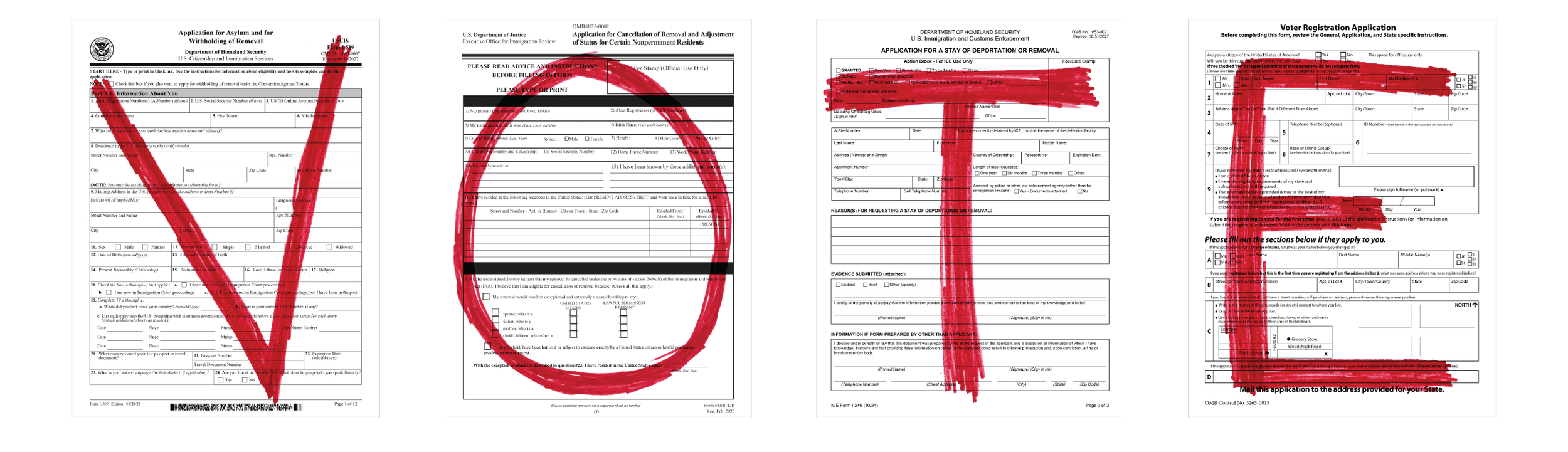
Visit vote.org to:
register to vote or confirm your registration
learn about what’s on your local ballot
find your polling place
sign up for election reminders, and more…
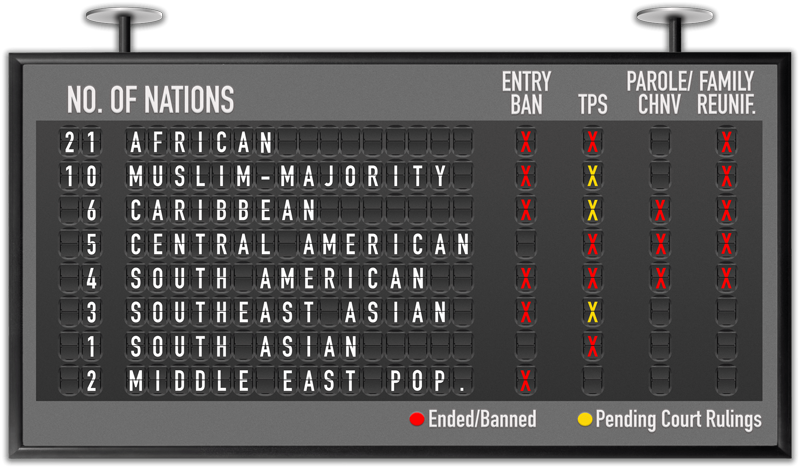
Extreme Immigration Restrictions
Since January 20, 2025, expanded U.S. immigration restrictions affecting dozens of countries have made it significantly harder – and in many cases impossible – for people to enter the United States, including for safety and family reunification.
Learn more from the National Immigration Law Center (NILC) and take action here:
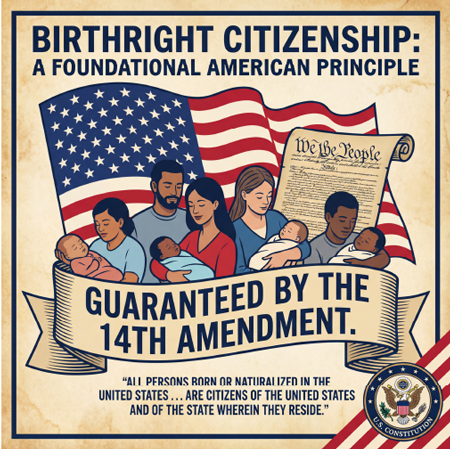
Birthright Citizenship
Since 1868, the 14th Amendment has been understood to guarantee citizenship to nearly everyone born in the United States who is subject to U.S. jurisdiction, with narrow exceptions such as children of foreign diplomats. In January 2025, the U.S. President issued an executive order seeking to end automatic citizenship for children born in the U.S. to parents without permanent legal status. It has been blocked by federal courts and remains under legal challenge.
Learn more from the American Immigration Council:
https://www.americanimmigrationcouncil.org/about-immigration/birthright-citizenship/

Homeland Defender
In September 2025, USCIS, the federal agency that handles immigration applications and benefits decisions, launched the “Homeland Defender” hiring campaign to recruit entry-level immigration services officers with up to $50,000 in signing bonuses. The campaign is part of a USCIS shift toward more intensive eligibility screening, fraud detection, and security vetting. National Public Radio (NPR) reporting stated that the current administration is transforming USCIS “into one of its strongest anti-immigration policing arms.”
https://www.npr.org/2025/12/10/nx-s1-5611495/trump-citizenship-immigration-services-changes
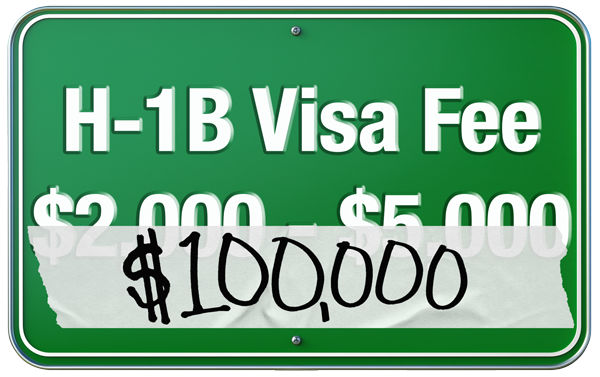
H-1B Visas
The H-1B visa lets U.S. employers hire skilled foreign workers in tech, science, and research. A 2025 presidential proclamation imposed a $100,000 requirement on certain employer-filed petitions for workers from outside the U.S., and directed agencies to explore wage- and skill-based selection changes, while the lottery system remains in place. The policy is facing legal challenges in federal courts.
Learn more from the American Immigration Council:
https://www.americanimmigrationcouncil.org/blog/trump-100000-fee-h-1b-visa/

Un-Stable Homeland
Kristi Noem was fired as Secretary of Homeland Security on March 5, 2026 after she testified under oath that the President had personally approved a $220 million taxpayer-funded advertising campaign for immigration enforcement that featured herself on horseback. Noem was replaced by Senator Markwayne Mullin of Oklahoma (DHS bio). In the President’s first term, the turnover rate for his Cabinet members was 60%, and 92% for his White House senior advisors. In his second term so far, turnover of his Cabinet is already at 20%, and White House senior advisors is at 32%.

Social Media Scrutiny
U.S. visa applicants must disclose five years of social media usernames to the U.S. Department of State for security screening that includes review of public online speech. Applicants have limited visibility into how decisions are made, including the use of automated assessment tools by federal agencies. Lawful speech may be misread out of context, weighted inconsistently, or misinterpreted as indicative of intent or ideology. These records can be retained for decades under National Archives and Records Administration guidelines, prompting advocates to warn of long-term privacy consequences and call for stronger safeguards and accountability.
Learn more from the Brennan Center for Justice:
https://www.brennancenter.org/our-work/research-reports/governments-growing-trove-social-media-data

refugee policy inconsistency
On January 20, 2025, the U.S. President issued Executive Order 14163 suspending the U.S. Refugee Assistance Program (USRAP). Eighteen days later, he issued Executive Order 14204, which includes the provision: “The United States shall promote the resettlement of Afrikaner refugees escaping government-sponsored race-based discrimination, including racially discriminatory property confiscation.” The suspension of USRAP and subsequent policy changes disrupted the U.S. refugee resettlement system domestically and internationally, creating backlogs and straining resettlement agencies, while a targeted exception for Afrikaner refugees under EO 14204 prompted legal, political, and diplomatic scrutiny of the admissions framework.
Learn more from Refugee Council USA:

pay to sway
In September 2025, the U.S. President issued Executive Order 14351 to establish the 'Gold Card' program, allowing individuals or corporations to expedite immigrant visa processing with a fee of $15,000 plus financial contributions ($1 million or $2 million, respectively). A recently proposed Platinum Card, requiring a $5 million contribution and $15,000 fee, would allow stays of up to 270 days annually without U.S. taxes on foreign income. Both cards are currently being challenged in the courts, particularly because Congress holds the authority to regulate immigration.
Learn more from Public Citizen: